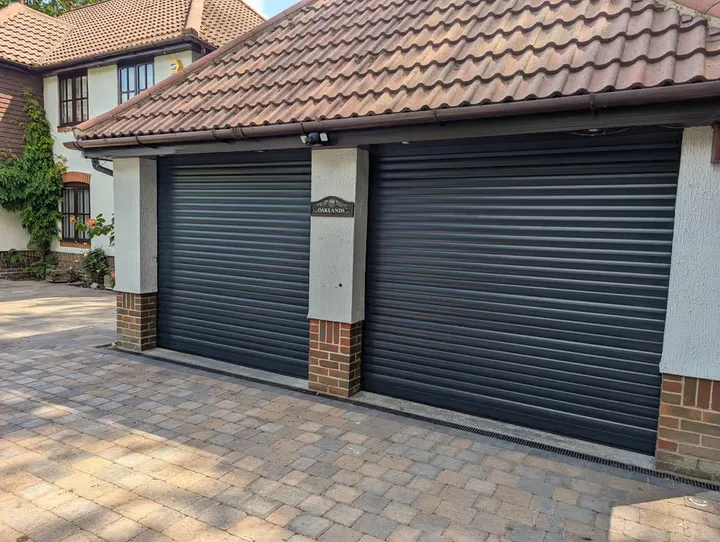
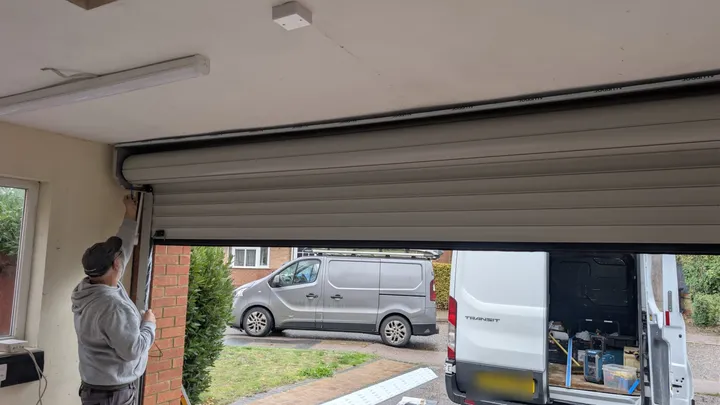
Every roller garage door rolls up into a box above the opening. The space that box needs is the headroom, and it is the one measurement that decides whether a roller door fits your garage without any building work. The good news is that the box is compact, the numbers are known, and most Essex garages have more room than their owners expect. Here is how headroom works, what RollRite doors need, and what happens on the few occasions it is tight.
What Headroom Means on a Garage Door
Headroom is the clear vertical space between the top of the structural opening and the lowest point above it inside the garage. That lowest point is usually the ceiling, but it can be a joist, a beam, a run of pipework, a light fitting or the track and springs of an old up and over door. Whatever is lowest sets the figure, because the box has to sit beneath it.
It is a different measurement from the height of the opening, which is the gap you drive through, and from the ceiling height of the garage, which rarely matters for a roller door. A garage with a low ceiling but a clear strip above the opening has plenty of headroom; a tall garage with a beam sitting hard on the lintel has very little.
How Much Headroom a RollRite Door Needs
The box size depends on the slat profile and the height of the opening, because a taller curtain makes a bigger coil when it rolls up. These are the boxes RollRite fit:
- 205mm top box. The standard 55mm door with 9mm slats, for openings up to 2,400mm high and 2,700mm wide, and the 12.5mm high density slat on openings up to 2,250mm high. This is the box on most single garages.
- 250mm top box. The 12.5mm high density slat on taller single openings, up to 2,500mm high.
- Up to 300mm. The 77mm profile, with its thicker 18mm insulated slats, used on wider openings and double garages up to 5 metres. The larger coil needs the larger box.
So the honest short answer is between 205mm and 300mm, and for a typical single garage it is 205mm. If you can fit a standard house brick and a bit on its end above the opening, a 55mm door will almost certainly go in. Our guide to 55mm versus 77mm slats explains how the profile is chosen, and the box size follows from that choice.
Side Room: The Other Measurement
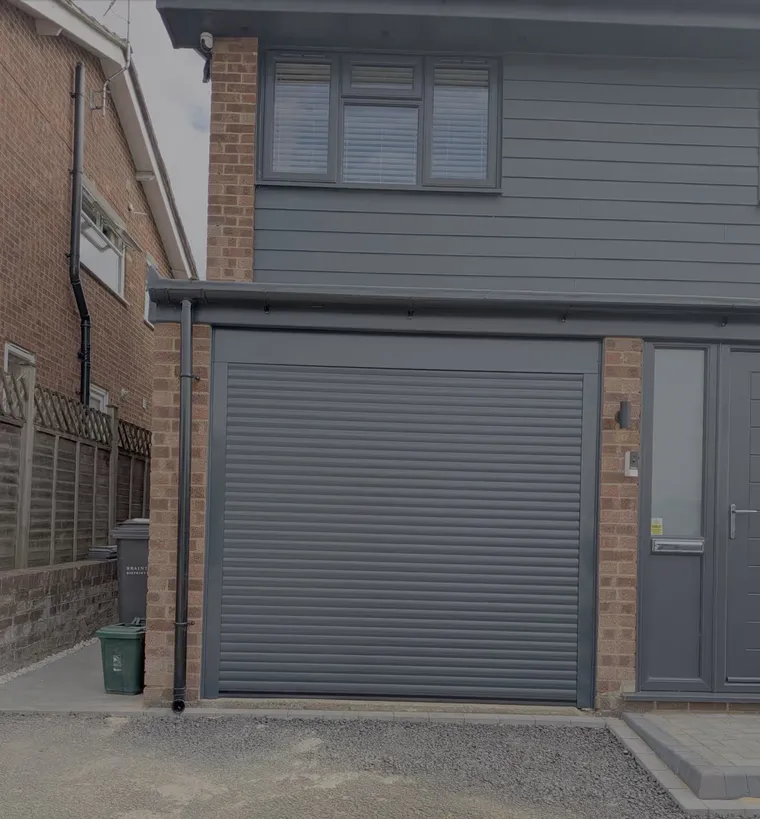
The guide runners that hold the edges of the curtain need approximately 75mm of clear wall on each side of the opening. They are what keep the curtain in its track, and they are also what stops the door being lifted or levered from outside, so they are fixed to solid brickwork or blockwork rather than to the old door frame. Most reveals have the 75mm. Where they do not, the door is face fitted instead, which the next section explains.
Reveal Fit or Face Fit
There are two ways to mount a roller door, and headroom usually decides which one you get. A reveal fit sits the box and the runners inside the structural opening, tucked behind the brickwork, which keeps the front of the garage clean and uses the space you already have. A face fit mounts the box and the runners on the wall around the opening, on the inside face, which keeps the full drive-through width and height when the reveal is narrow, uneven or short of headroom.
Neither is better; they suit different garages. The survey settles it on the day, and the price is the same either way because every RollRite price includes the door, motor, box, guides, trims and fitting.
When the Headroom Is Tight
Occasionally an opening has less than the box needs: a beam across the lintel, a flat-roofed garage with the joists sitting low, or an old door whose track has been boxed in. There are three ways through it, and the survey tells you which applies:
- Use the smaller box. Where the opening height allows the 9mm or 12.5mm slat on a 205mm box, that is the first thing we check.
- Drop the box into the opening. The box can be mounted lower so it sits partly within the opening. You keep the roller door and lose some clear height under the box, so we measure the car first and tell you the finished height before you decide.
- Face fit. Mounting on the wall around the opening sidesteps a narrow or uneven reveal and often finds the extra millimetres a reveal fit could not.
What we do not do is guess. Every door is made to measure, so the numbers from the survey are the numbers the door is built to, and if a roller door genuinely will not fit we say so on the driveway rather than on installation day.
Why Roller Doors Suit Awkward Garages
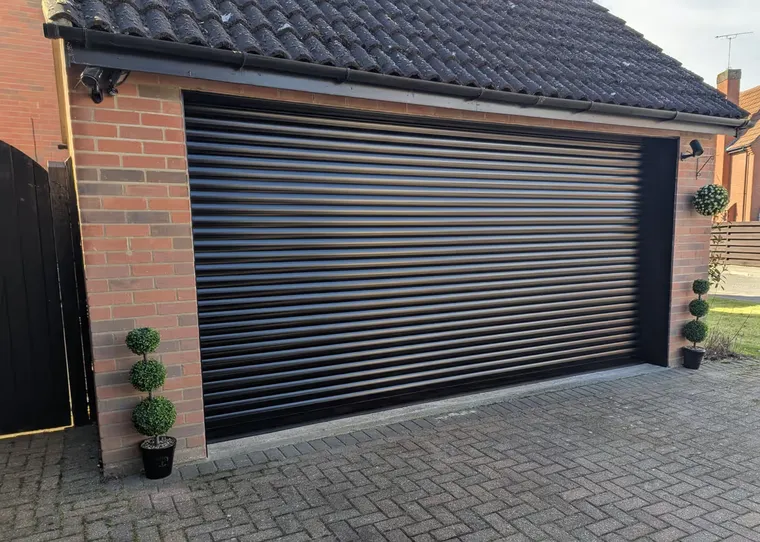
An up and over door swings out across the drive and runs back along the ceiling on tracks, so it needs clear space in front of the garage and clear space inside it. A sectional door also runs back along the ceiling. A roller door does neither: the curtain goes straight up into its box and stays there. That is why it suits garages with low ceilings, storage racks or shelving along the walls, a bike hanging from the joists, or a room above the garage. Our comparison of up and over and roller doors covers the trade-offs in full.
It also helps with the drive. Because nothing swings out, you can park right up to the door, which on a short Essex driveway is often the difference between the car fitting and not.
Measuring Headroom Yourself
If you want a rough idea before we visit, stand inside the garage with the door open and run a tape from the top of the structural opening straight up to the ceiling or the lowest thing above it. Take it at both ends and in the middle, because lintels and ceilings are rarely level, and write down the smallest figure. Note anything in the way: pipes, cables, a light, the old door's springs and track. Then measure the clear wall on each side of the opening for the 75mm the runners need. Our guide to measuring your garage opening covers the width and height of the opening itself, and the three numbers together are what our cost calculator uses to give you a fitted price.
None of this is required. We take our own measurements at the survey whatever you send, and the door is built to ours.
Not sure what your opening has above it? Book a free survey and we will measure the headroom, side room and opening and tell you exactly which door fits.
Book a Free SurveyWhat It Costs
Headroom does not change the price. A RollRite roller garage door costs from £1,275 inc VAT fully fitted for the 55mm door with 9mm slats and key switch operation, with remote control packages that include a safety edge from £1,475 inc VAT. The 77mm profile for wider and double openings starts at £1,790 inc VAT, and the largest doors with colour and extras come in at around £3,400 inc VAT. Any colour other than white adds £100. Our roller garage door cost and packages page sets out every package and what it includes.
Key Takeaways
- Headroom is the clear space above the opening, and it is where the box goes.
- RollRite boxes are 205mm, 250mm or up to 300mm depending on the slat profile and the opening height.
- Each side needs about 75mm for the guide runners; a face fit covers reveals that do not have it.
- Tight headroom has three answers, and the survey picks the right one before you order.
Conclusion
Most garages have the 205mm a standard roller door needs, and the ones that do not usually have a way round it. The measurement is quick, the box is compact, and the survey is free. Measure the strip above your opening if you are curious, then let us confirm it on the driveway.