You do not need to measure anything to get a roller garage door from RollRite. Our surveyor measures every opening before a door is made. But if you want a fitted price before anyone visits, our calculator needs your opening width and height, and ten minutes with a tape measure will give you both. This guide explains how to measure a garage door opening the way a fitter does, so the price you see is close to the price you get.
What You Are Measuring, and What You Are Not
The first rule is the one most people get wrong: measure the structural opening in the wall, not the old door. An up and over door usually sits in a frame that is bigger than the hole behind it, and a sectional door can be larger still. A roller door is made for the opening itself, because its guide runners fix to the walls either side and its box sits above.
Work in millimetres. Roller doors are manufactured in millimetres, the calculator asks for them and a few millimetres is the difference between a snug fit and a draught. If your tape only reads inches, multiply by 25.4.
Step One: Width at Three Points
Measure the clear width of the opening from brick to brick, or frame to frame if the frame is staying. Take it in three places: near the top, at the middle and near the bottom. Openings in older houses are rarely perfectly square, so the three figures will often differ by a few millimetres. Write all three down and keep the smallest. That is your opening width.
Step Two: Height at Three Points
Now measure from the garage floor to the underside of the lintel, again in three places: at the left side, in the centre and at the right. Floors slope towards the drive to shed water, so measure where the door will actually close, at the threshold, rather than further inside. Keep the smallest figure. That is your opening height.
Step Three: Headroom
Headroom is the clear space above the opening, from the underside of the lintel up to the ceiling, a beam, a pipe or anything else in the way. A roller door needs enough of it for the top box, which is typically between 205mm and 300mm depending on the door size. Measure the smallest clear height you have and note anything that intrudes, such as a light fitting or a cable run.
If the headroom is short, do not give up. A face fit mounts the door on the wall around the opening rather than inside it, which can recover the space. The survey decides which fit suits your garage; your job is only to tell us what is there.
Step Four: Side Room
Side room is the clear wall space to the left and right of the opening, measured from the edge of the opening outwards. The guide runners need approximately 75mm of clear space on each side. Note anything within that zone: a meter box, a downpipe, a light or a wall that stops short.
Step Five: Note the Power and the Old Door
Two more things are worth writing down, though neither is a measurement. First, where the nearest socket or power point is, because an electric roller door needs a supply. Second, what kind of door is there now and how it is fixed. Removal and disposal of the old door is included in every RollRite installation, so this only helps us plan the visit.
What Your Numbers Mean
Our 55mm packages are built for openings from 2,200mm to 2,700mm wide, which covers most single garages. Wider openings and doubles move into the 77mm range, which runs up to 5,000mm. If your width sits near a boundary the survey will settle it, and our guide to 55mm versus 77mm slats explains what the two sizes are for.
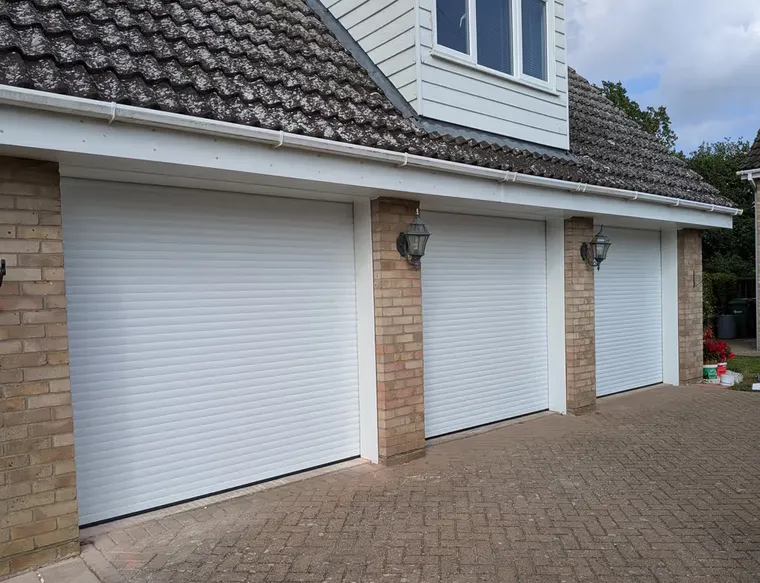
Where to Put the Numbers
Our roller garage door cost calculator asks for the opening width and the opening height, in millimetres, then lets you choose the slat size, the colour and the controls. Prices start from £1,275 inc VAT fully fitted and scale with the width you enter, so an accurate measurement gives an accurate price. The roller garage door cost and packages page explains what each package includes.
Rather have us measure? The survey is free, takes under an hour and the quote is fixed.
Book a Free SurveyWhy We Still Measure It Ourselves
Every door RollRite fits is made to the measurements our own surveyor takes. Your figures get you an early price and tell us what to expect; ours are the ones the factory works from. The survey also settles the things a tape measure cannot: the fit type, the state of the lintel, where the motor and controls will go and how the old door comes out. Our guide to what happens at a garage door survey covers the visit step by step.
We are based in Sible Hedingham, near Halstead, and cover all of Essex plus parts of Suffolk, Hertfordshire and the east London border. Call 01376 800 750 with your numbers, or book the survey and let us bring the tape.
Key Takeaways
- Opening, not door: measure the hole in the wall in millimetres.
- Three widths, three heights, keep the smallest of each.
- Headroom for the box and side room for the runners decide the fit type.
- Your numbers get an early price; our surveyor's numbers build the door.
Conclusion
Ten minutes with a tape measure gives you a fitted price you can trust, and the survey takes care of everything the tape cannot. Measure once for the calculator, then let us measure again for the factory.